Sunday, May 22, 2011

Fri. Exhibitor Breakfast, Lunch, and Exhibit Hall

Exhibitor Breakfast, Lunch, and Hall

Very exciting! I so wish CLA and ALA would take a tip from these exhibitors. Be prepared for a million pictures.

We started with lunch and then hit up the exhibitors – including museum consulting and design companies, manipulative companies, exhibit rental companies, other museums with rentals. For some reason it seemed smaller this year – but it could have just been a different space (economy we thought maybe?).

Highlights –
Argyle – picture of tot area
Boss – amazing ball machine – we all want for 2nd floor!
Jack Rouse – pin wall!
Kidzibits – lightbright
Luckey climber – enough said!!
Snug vs. Imagination playground – Jason is leaning towards IP – I’m Snug, this is something (if we have money) we can get right now and use at SRP kick off, finale (any cultural arts night – school nights, outreach visits). It works inside and out – but I think we would want outside because gross motor play = fun = laughing = noise = shushing.
Playcore – learning materials – working with snug
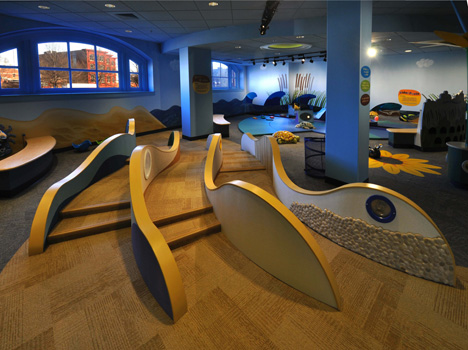


Argyle Design – Designed the “Kidtroplis” area of the Houston Museum as well as the “Waterworks” area of the Houston Museum. We got to see photos of a very nice tot area - "Port Discovery" Baltimore. It was of a tot area – Maragret, Renee, and I loved – will probably be in all our blogs. It was beach themed – had a great immersive quality. Had small “walking bridge” which seems to be in all tot areas – this one lined in beach stones – appeared as waves on the outside, but appeared as sand and pebbles on the inside – great tactile experience. Really well done.


Boss Display - Renee and I saw last year – they have a gorgeous “Rube Goldberg” piece in San Diego called “The Kuegelbahn.” They had another really nice ball piece – three pieces with clear front, rainbow balls. We asked about cost of a small section of it and materials. The clear front - “lexicon” front – which is better because screws wont crack and does not scratch as easily. The base is made of “boat board” or marine board – very durable form of plastic. I believe the cost for the small section (4 x 8) was about $7,500. Renee, Margaret, Jason and I thought was super!


Jack Rouse – Very friendly, knowledge, open about pricing. They had a photo of a pin wall they built. For a 4 x 8 section – it would be about $4,500 – 6000 for just the pins alone through a separate vendor. They will build an automatic reset case for the pins – total cost with the pins $25,000 - $30,000. There work was really nice quality, very polished.


Mindsplash design – We sat at their table on the first day of conference during the breakfast hour. Very friendly. They are the museum consultation and design firm, with experience from Dupage. They had a cute airway wall exhibit with air tubes – scarves and balls.


Kidzibits – Renee and I also spoke with this group last year. They create a light bright exhibit. Renee spoke to him about pricing – which I recall being very expensive. Houston has a small lightbright exhibit in their tot area – not sure – but could be from them?


Luckey Climbers – Wow. Wow. Wow. I hope our second floor will be able to have one. Both Jason and I saw it and knew hands down – that’s it – it’s awesome! We need one of these! Luckey Spencer was very nice when we spoke with him – being an artist he’s a bit eccentric, but very nice! His booth was really simple with just a few posters. He had a gorgeous huge climber with rainbow colors - $400,000. He said a smaller climber, closer to the one we saw at the Houston museum would probably be $100,000. I asked him about construction – onsite, offsite? Time? He said about 2 to 3 weeks. The bolt all of the climbing poles together at the shop, it’s the cabling that takes time, which they do on site.


Murphy Catton – They did Pretend City. Asked about sq. ftg. Cost. Told us it is all custom. Nice, but absolutely zero info. I did get a squishy frog from them.

Science Kinetics – Margaret found some neat stuff there. She loves their electric harp and their “coin vertex” or hyperbolic ___? $2,000 for basic floor model.


Children’s museum of San Jose – Selling pin walls – for a 4 x 4 section $16,000 (gives 66,000 pins) – with no case. They say there pins are better. They also have a gear set (not any better than the ones Margaret found for us)./ These just have number s and can stack.

Ontario Science Center – They had cool looking ball tracks and runs, but they did not operate well.

Imagination Playground – Very cool. Part of big movement for “loose parts play”, free play, child driven play. New York City has huge park (staffed by attendants). Pieces are all light blue, stack easily together (pieces can be stacked on top of each other into a tower – putting children as high as 4 ft off the ground. Purchased storage cart has wheels and can be kept outside. Jason is a fan! He thinks it might be safer – lighter weight – so if children hit each other, not hurt as hard. http://www.youtube.com/watch?v=oHVAn7SdmbU


Snug – Sat in a session that discussed story of snug. Created by visual artists, through experiments and children – over a period of 3 years? Has been in UK for 4 years? UK has a large public area “Gillets Square” – you tube video of it http://www.youtube.com/watch?v=WnxOcMUDDG0&NR=1. Someone puts pieces out at beginning of day (no staffing, no policing, no stealing), someone puts it wawy at the end. Chicago Museum has indoors. Chatanooga also has indoors (they also presented at several sessions). Snug is heavier (children can still pick up – but more substantial. Bright colors, but not primary and obnoxious. Polyurethane coated? Seem sturdier. Smallest set starts at $4,995 handles about 15 children at a time. Starter kit - $8,995 will play about 20 – 25 kids. I’m a snug fan because it was created based of experimentation, are colorful appealing to more of the senses – thus more learning, more substantial and durable, unique tested shapes. It will be harder on a staff end to move and set up, but the Snug representative said the way they do it in England is involve the children. This is there play. They carry it out and put it out away “like little ant helpers.”


Wentzcope microscope – This was cool. I think it is an extra rather than a necessity. Very cool though. It was a huge microscope that you can see standing up and don’t need to look into. We got to see cards with pieces of things to look at up close – tea, spices, bugs (eww), FEATHERS.

Playcore – First time at ACM – seems like a good company with products built on lots of knowledge. The woman with the company was a former teacher, whose passion is play and inclusion. They’re sending Margaret and I free booklets on play activities and verbage on how to talk about inclusive play. I think we can use this to support current programming (and as we grow) – especially in establishing (down the road) – scripts and training materials. While they’re an outdoor company – and we don’t have much of an outdoor space yet – there may be some products we can adapt or think about for future use.

Benees – Had cool vinyl covered squares – you can print custom images. We liked the zebras and animal squares. The didn’t look very durable. He said his set lasted two years. They could be cleaned with a light bleach solution, but not scrubbed. Depending on cost – something very cute for family place area, but not a necessity.

• Did not see booths for these vendors advertised in booklet– Nassal, redbox, heartland scenic studio, exhibits inc, big think creative alliance, Clifford wagner science, Kubik Maltie, Lexington (Skirball designers), Saw Horse Studio, Universal Services , Vee

It was very good to see what’s out there and keep a pulse on whose doing what, pricing, and what is available.

Fri. Importance of Risk 10:45-12

10:45 – 12 Safe As Necessary, but Not As Safe as Possible

Kia Karlan – Madison Children’s Museum
Carly Baumann - Providence Children’s
Aaron Goldblatt, Metcalf Architecture & Design
____________________

Synopsis:

This was a good program! I give it an A-. The Madison museum was a presenter (they presented in several sessions, as well as Chicago – I think they were the stars this year). The point of this program was to talk about the importance of designing exhibits that allow children to feel a certain element of risk, which is a critical part of their development. It’s called an “executive function” to be able to make judgments and determine if one is able to safely maneuver their environment. The example she gave – I can jump off this boulder and be safe, but not this cliff. Children cannot develop that function without the opportunity for experience. The trick is how do we balance providing that experience, while still being safe enough for parents and insurance companies.

Kia Karlan from the Madison children’s museum had some wonderful ideas they were using at their museum. Obviously, the main importance is 1st to tie in to the mission of their museum (being as green as possible), what’s best for the children, and what the community wants.

Best exhibits – gerbil wheel (looks very dangerous and people do get hurt), also look like a lot of fun. They handle the risk with signage and museum attendants. Good training for floor staff and key component is professional staff always being available to handle situation.
- Rooftop garden – grow organic produce, invite local chefs to prepare fresh eggs from chicken coop (it would be really cool if we could do this – perhaps we could partner with Grapeland elementrary and their school garden)

Carly Baumann
Providence Children’s
Best exhibits – Luckey climber!

Aaron Goldblatt, Metcalf Architecture & Design

Morse Arboretum – Philidelphia (in conjunction with University) –
http://www.business-services.upenn.edu/arboretum/gardens_treeadventure.shtml

Created a structure that would walk guests down a long walkway, taking them high into tree tops. Once at the top of the tree tops, giant (almost invisible) net structures are like large swimming pools where children and families can look down and lay amongst the trees. P.S. The tree trunks sway – I think as much as 3 ft with the wind. There is also an “inclusive” experience – wheel chairs can ride onto a narrow walkway that “disappears from site” and allows them to feel like they are a part of the experience.

This feeling of risk promotes social connection – people talk to strangers and stay and socialize and bond over amazing experience.

Really unique idea! Great point to think about as we perculate on what happens with the second floor and the importance of providing these experiences. And helps us to think about space in a new way – if these people can create something in the tree tops – what areas do we have that we haven’t thought about?

Maeryta was also in this session and raised the question at the end of the session – what about an inclusive experience for all? How do you deal with not or providing this experience to be “inclusive” (special needs, autism, wheel chairs, etc). for all?

The museums dodged this one a bit – saying that not all experiences were for all visitors. Important to think about when designing – will all be inclusive – just some – modified experience?

Also interesting to note – there are guidelines for program safety, guidelines from the Smithsonan, and other agencies on safety of design. Apparently it is critical for museums/exhibit designers to know these guidelines and to work with fire/risk management – but that not all of these safety guidleines will apply. Apparently a slide (depending on it’s size and incline) – must have 4 feet of “fall space”. There is apparently technical training/certification on playground safety guidelines.

__________

Notes / long version:

About sharing. 1992 – Madison – started as floor staff. 1995 Bay Area Discovery Museum – saw soap box derby, saw candle making. Programming ever since at Madison. Madison open for 35 years. Opened newest facility – from 9,000 to 25, 000 sq. ft.

1999 – First Green exhibit Early Learning Space: safer healthier space for young children, looking at materials used in environments (health issues from off gas chemicals), All hard surfaces – museums upset all hard surfaces, adults kept falling on stairs that had odd pitch for young children walking

The City Museum, St. Louis, MO (very cool) – open ended, risk tolerant museum, climbing experiences

Decline in emergency room visits – now obesity on the rise “Last child in the woods”
One in five kids suffer depression (ages 9-17) – 80% go untreated – American Academy of Pediatrics

Executive function (jump off rock ok, cliff not fine) – todays 7 year olds have executive function of a five year old

2010 August, New MCM – no rules, minimum signage, early learning space up high )suspension bridge over trees nest, water play, climbing area and slide (parent concerned email –child thought slide too fast – early learning coordinator sent email – developing self regulation skills will be al the more exciting for her when she’s ready), problem is floor staff respond - yes, your’re right – rope off slide – need work).

Signs – ages 5 and under

Possible-opolis open ended for kids – the wayback machines, floor has as much salvage material as possible

Climber – hodge podge mahal, recycled pieces, freak outs inside top point , parents cant grab kid, kids help each other, toddler shave jeep climber, have climber monitor, added wings and spiderwebs to keep footholds off, did make signs (talked about comfort level)

Gerbil wheel – just over first floor (can see through down to first floor), first accident report was director of dupage museum with executive director of Madison running gerbil wheel, sign 4 years and up, only two at a time, no running, carrying children into wheel, start slow

Rooftop ramble – live animals, chickens, parents glad when chickens peck – teach children, germ swab elevator, stairs, and chicken

Cook food from garden and solar oven (some parents upset not packaged) – no problems, have guest chefs come

Woodworking classes

Resources:
www.free range kids.wordpress.com
www.childrenandnature.org
www.tinkeringschool.com
www.citymuseum.org
wwww.madisonchildrensmuseum.org

Carly Baumann
Providence Children’s 162,000 visitors in 2010, 17,000 sq. feet
Luckey climber outdoors! Nooks and crannies not conducive to adults, gives kids a chance to play and breathe, spooky and scary (skulls and bugs), was scared now not, programs important to risk taking, get daring with materials tools and mess, animal programs, kids practice with tools, hammers
Don’t just staff risk places, communicate with adults our feelings on risk, open to how people experience, parents so worried, integrated in training, mentoring sessions, shared language. Play watch captures stories about play.

Toddlers injured on ladder – we need to do a better job communicating to public. Recommended age 4 and older - design what makes sense to viewer.Teach parents what developmentally appropriate. Climb arch mat. Gave power back to kids

Risk is fundamental element of play. Without some level of risk, will not want to play. Arboretum – ask kids – what will be fun – climb trees (can’t let kids climb trees). 450 ft. long, pavilion in center, 50 ft. off ground, invisi-net, can’t see it, like a giant hammock , mission – help love trees, experience tress in a new way, bird’s nest, with giant eggs, dangle feet in net, trunks are moving, net moves, social setting, allows crossing boundaries of social hood.

Philidelphia Arbortium – Morse Arboreteum (deals with University)

At please touch museum – wild thing.

Risk taking – promotes social bonding (ex. Elevators here)

So worried about litigation – ladder access point in highest area (in event of terrorist point), insurance carrier (have good relationship – they will help do risk analyses), code officials - , suspension bridge climb up and over top (tight weave) curved so no problem, no railings in football stadium (42 high) – no kids climb, cameras make kids and parents feel better (interact, can see kids), reassure parents 9parenting in public – don’t let kids climb)

How measure own comfort/safety level (parent ok / staff not) (ex. Playdome mistake in design – looks like climb outside – added foothold blockers) - design in key (always observe / watch – redesign)

Museum should know all guidelines from consumer product safety commission – irresponsible not to now them. Look at context – museum not playground. They are guidelines – museums will have different guidelines (trained playground safety), what is your risk level, work with insurance company, how much liability will you take, number of visitors, cultivate dialogue with city/fire/ everything early – partners in effort

Climber inside – playground rules, but not playground, ada rules? (Maeryta?) climb ladder to access (Smithsonian guidelines)

Madison – not every exhibit has an experience e- look holistically for viewers

Fri. Plenary 9 -10:30 - Milton Chen

Day 2 ACM 2011 Friday
Dr. Milton Chen

Importance of education in informal learning environments, what we need to change
_______________________

Synopsis (see usable ideas below):

Wow. Really inspiring. I give it an A + (I would only add more time to his presentation). I think he should do a documentary. Best news – his actual presentation will be available to ACM members on the ACM site (as will all the keynote speakers). I think it is a must see!

When I saw Dr. Chen worked for Lucas – all I could think about was Star Wars. The woman who introduced him even came out as darth vador. Forgive me Allen – I forgot all about Star wars once he started his presentation. He’s definitely got “street cred” with his many years behind educational programming – sesame street, 3-2-1 contact, and working with the mother of all technology – Lucas!

His presentation was about putting children’s education first, why children’s education is so critical for our nation and for the children. And my favorite part – what can we do about it. It is so hard to hear about the bad state of things when no solution is provided.

Set the stage with this quote - “If you ever have anything to do with their food, healthcare, education … listen to the children…think of them children first.” Fred Rogers

Dr. Chen started – of course - with statistics to set the stage and create an understanding of where we are (statistics are always alarming – a high school student drops out every 60 seconds). If we closed the gap in education that we have – it could contribute 2 TRILLION dollars per year to our GDP. He spoke about where we are technology wise – how far we’ve come – put it in perspective – in such a short time. Google is only 13 years old (that’s the same age as my step daughter!)! Youtube is only six years old.

The point is that our world has changed dramatically in the last decade (can you remember the time before the internet – for some children they don’t have that)and our education needs to reflect that change. Children need to see the connection of the real world in their education at school and see what they are learning in school in their real world. He compared school to sitting in airplane – sit in the same small uncomfortable chair, face forward, don’t move. We educate kids from neck up – we forgot we all have a body.

The new education needs to involve - Documenting, telling stories, teach value activities and space, get into communities, activates all those different howard gardner intelligences, gardner offers better learning – hands and minds on, bring friends, all learning. This was another great quote from him – “kids vote with their feet.” Meaning you see when they are passionate – running into school, a movie, to play. You can see when their feet and bodies are dragging – fighting the learning.

Making learning exciting – inspiring their passion – is what needs to happen – it can and does. We then got hear about the exciting programs that are “the change”. Technology is a powerful tool and we should be using it for education to teach 21st century skills - the creative problem solving skills for jobs that are not yet created with technology we don’t yet have.

He broke down how the system can change with a series of “edges” – key points necessary (Margaret will cover in her blog).

Some of the wonderful projects he covered which I think we can implement in our programming right away (the caveat being of course – staff, time, money, resources)! I can see family Saturdays, discovery clubs, back to basics, teen programming, and even our tech department (possibly) offering more classes. I could seen building on amazing teen program Linda did with GIS (she’s cutting edge!).

The bottom line is – if our resources only provide us the opportunity for one program – how much do we want to make it count towards helping our children for the future. If I get one program – I want to make it count if I can.
___________________________

Useable progams:

Examples of great programs:
- DC /FS -Google art – kids can take virtual tours of the world’s art museums, can create their own mini exhibition with youtube
- Back to Basics / school outreach - “Opening Minds, Opening Hearts – Phoenix” – Bring in singers, actors, create “language rich environment” where kids can act out words – help literacy. Teach through the body
- Have kids become teachers – teach technology and teach each other. Generation yes (genyes.org) – teach teachers to teach technology. Create web content.
- Tech (tween/teen) - Technologies East – East labs (environmental and special technology – little rock Arkansas) – Margaret explaining in her blog. We could use laptops in programs, maybe do in place of a tech class once a month. Give kids the opportunity to create a project for the community (ex. Of what students did – create a bird sanctuary for the school, create a football stadium for the school – they have to figure out where funding will come from, design and plan).
- Local History: Arkansas Forgotten – Japanese internment camps. Like Linda’s teen program - Kids using gps went out to track the locations of the forgotten camps.Want to record so never happen again. Created a memorial garden at school. (Riverside city museum has a wonderful exhibition on this) – The point is to get kids into the community, interacting, making an impact. We could use with local history.
- DC / Family Saturday – Science / technology - Watershed project – kids doing scientific measurements- temp, water quality. Many children had not experienced nature (never felt my shoes off concrete, I didn’t know birds made sound). We would have to bring nature indoors – partner with local organizations to bring in (encourage family visits and awareness for off time)
- Outreach – what do schools need / lack – bring highschool and younger schools together – ex. Elementary school supposed to visit caves (?) on a field trip – due to funding could not go. High school students documented for kids (cave visits) so they could visit virtually..
- DC/ FS/Teen/Tech/Outreach – ex. Hirsshorn museum held a workshop where students needed to be the teacher and create a scavenger hunt using the museum art pieces and cell phones. This scavenger hunt was supposed to be for kids their age and excite them about coming to the museum – the kids loved it! They created a story , filmed it, and the whole hunt. We could do this with the library, local history sites, get GIS involved and do a geocache project. It was *REALLY* amazing to watch and I think a very exciting way to connect all the pieces.
I could go on and on, but I’m going to wrap up. I hope we can work towards integrating whatever we can into our programming and be a part of the change.
_______________________________

Notes (long version of what's above):

Goals for ACM
Grow and demonstrate the impact, leverage collective power, promote the value, achieve sustainability, ensure a strong association.
Jane Miller Pittsburgh – Darth Vader
“Education Nation” – Jane previous teacher.
“If you ever have anything to do with their food, healthcare … listen to the children…think of them children first.”
Milton Chen, Jedi Master, at his 50th birthday. Share thoughts about future of education. We are in the midst o redesigning American educational system. ACM leveraging collective power important. What do we need for an education nation – children first? Educating children first?Are nation’s strength depends on the education of our children – economy, etc.
Of 50 1st grade students behind – by 4th grade still behind
A high school student drops out every 60 seconds
CA students 1 year behind US average
Closing the gap could contribute 2 trillion per year to GDP
Text on the screen talk back to you and help you.
We need “gray” area of learning. Kids learn in school – but more leaning take place outside – museums, libraries, churches, parks, etc. “Ladder of Learning”. Edutopia (George Lucas Website) – ability to see film over internet caused tremendous growth. Over 500,000 people on website per month – half from other countries.
Innovation is the key to creating education nation. Don’t just say – oh that’s nice. Bugscope.org – see bus under microscope. Move to must do.
Internet still young – google 13 years old, you tube 6 years old. Look at how this decade has changed. Seeing images changes everything – promotes innovation. Every minute – 24 hours of new video on youtube. We are in the greatest expansion of human creativity. Kids can create in ways we have not imagined.
Schoollife = real life. No longer wasted material. Digital immigrant vs. digital idiot. Can you remember life before the internet? The key is having kids understand how school applies to daily life and how daily life applies inside of school.
6 Leading Edges of k-12
1. Thinking 2. Curriculum & assessment 3. Technology 4. Time/place 5. Co-tea ching 6. Youth
Compare school to sitting on airplane – sit don’t move for 2 hours
Google art project – world’s greatest art museums – bicycles ridden through the worlds greatest art museums. Kids can curate their own art exhibits.

Opening Minds, Opening Hearts – Phoenix – help kids get to 4th grade reading level. Surround kids with a language rich environment (feel words with body) act out.
Educate kids from neck up – forgot we have a body. Have kids become teachers – teach technology and teach each other. Generation yes (genyes.org) – teach teachers to teach technology. Create web content.
Technologies East – East labs (environmental and special technology – little rock Arkansas) – after school design buildings, make films. This is a problem solving class, not a computer class.150,000 needed to raise for teacher training.
Average teenager goes outside for only 20 minutes a day. Bird house, football stadium.
Arkansas Forgotten – Japanese internment camps. Kids using gps to track. Never happen again. Films. Memorial garden at school. Kids can make an impact.
Watershed project – kids doing scientific measurements- temp, water quality
EAST conference – 2000 attend, present projects, awards

21st century skills – communication, tolerance, ambiguity

Document, tell stories, - value activities and space, get into communities, activates all those different howard gardner intelligences, gardner offers better learning – hands and minds on, bring friends, all learning.

High school students documented for kids (cave visits).

Job description – not a solo practitioner, key to new education, collaboration between adults

Curriculum Edge
- Social/emotional learning, globalizing the curriculum, bilingual education for all, real work life: linked learning
- Castle.org (important intervention in schools, lift schools learning levels)/ Roger castle – this is the plate – the foundation of children’s ability to learn and work with other students
- connected California.org
- You can do STEM and global stem – kids in inner city Chicago learning Chinese (Chicago has largest Chinese program – teaching mandarin)

3. Technology edge
- Weapons of mass instruction one on one (250 dollars per year – 1 laptop) take textbook money and put into technology. We need to make this transition.
- Concert and pay for
- Oregon Assessment of Knowledge and skills (OAKS) – same standardized test, but online, students liked it better, answered more questions
-
George Leonard (Education and Ecstasy - book)
If learning is pleasurable – students will learn in one third of the time.

Escondido – all students have Ipod touch. Kids engaged in learning (attach microphone to it). Microphone records he reading. Kids listening to themselves read (kids persist longer – do it more) Parents and teachers and other kids can hear them read.

Tesselation – 3rd graders know because of technology

Learning I snow 24-7-365.

Hirsshorn Museum – ask middleschool students to create an activity while other students there
Workshop – create scavenger hunt at museum (use cell phone for clues).
Game is to look closely at the art (Zoo keeper, find lost animals is there theme)

Mobile, play space learning, have with you all the time

How can the institution be in the center of the kids life?
Now a set of tools out there – free – makes assets accessible (one that wont come – too far, not part of culture)
Visual literacy – how to translate interpret, look at objects / interpretive skills / words to choose, how to write, empowered to follow a personal path, will feel more confident, will believe in creative process, believe that they can make a creative contribution to this world
Going from production to participation, peer base collaboration, both learning and teaching (discover what you don’t know)
4. The teaching edge: co teach
- Parents as coeducators
- Linking home, school, many places
- Experts as co-educator: librarian, museum educator, scientist, historian,
5. Greatest edge: today’s youth
– 95 % stakeholders
- Digital natives carrying change in pocket
- Generation yes
Eduoptia – Jaelyn from Chicago
Virginia – gave up facebook for lent, teaches internet safety to younger kids

What is definition of great learning environment (museum, school, afterschool0? Make it short – make it measurable

Great place walk in, kids engaged, learning .. (change to a sentence or two – how measure that)

Do they run in at the same rate they run out? Kids vote with their feet for your environment


CHILDREN'S MUSEUM OF HOUSTON 8pm-10pm


The CMH was voted #1 children’s museum by Parents Magazine so I was really looking forward to seeing what it was like. The exterior featured columns in the shapes of children which was very welcoming. Upon entering the building there is a grand hallway with bright, colorful archways and two big gear machines framing the ticketing area - airy and bright.


After a buffet of Mexican food which was pretty tasty, we wandered around the museum. It became quite apparent that each of the exhibit spaces are packed to the gills. The 90,000 square foot building is easy to get lost in! I’m sure they get lots of visitors and I wondered about the quality of time spent inside areas crammed with so many items. In some areas I had the feeling like I was in Chucky Cheese!


I think it was hard to determine the themes of some of the rooms because the signage was always in different locations in the exhibit room. Themes were incorporated into the archways, posted on plaques, located from drop down signs from the ceiling, posted high on ceilings. There was not a cohesive look to the museum.


Flow Works – outside water play area next to naturalist cabin. The water exhibit was huge! Big cannons shot water into a giant cauldron and when cauldron filled up would dump water down as a big waterfall. Long locks and water flow exhibit. You can build a boat and float it down the exhibit.


The outdoor area also featured a naturist exhibit with a wooden cabin and garden. Inside the cabin there was a sad exhibit with chicks in a bubble – Angelica made me depressed. As an aside – we shared a Super Shuttle with a man who presented from the Madison Children’s Museum and he also said he felt uncomfortable with the treatment of the chicks. He said at their museum they have a chicken exhibit too, but they have a coop and children like seeing the chicks grow up. They have birthday parties for the chicks! Children make cards for them. They’re working on a carrier pigeon project too and are in the training stages of having pigeons fly to the children’s schools to transfer messages wearing WWII harnesses. The area featured a wooden sand table created around an oak tree with bird tracks on a board and bird track stampers for the sand. The also had a little exhibit where children could make rubbings of different leaves.


The museum had an extensive fitness activity area – big chase the light game board on floor, stretch and touch the lights activity, a dance dance revolution type of game, virtual jumprope using lights and a pulley race. Another area had a rock climbing wall and virtual surf/snowboard big screen game. I tried it and kept falling off the mountain - no balance!


Power Tower!
One of the most impressive features of the museum is a huge 2 story Lucky Climber. Jason and Angelica clambered into it - I don't think I would have been able to get out of some of the spaces. It's enclosed by a flexible metal mesh so kids can’t fall out. No croc, flip flops allowed. Ages 5 and up.


I liked their Tot Spot. You had to wear booties over your shoes and their were some nice inset wall toys – including a light bright, swiveling blocks, dollhouse rooms. I think they also had some sort of fragranced air being piped in.


Don't worry Angelica - someday we'll get a light bright!


Museum staff were very open and welcoming but not sure how knowledgeable. We walked through a room exhibiting Mexican artifacts. I was told by the eager museum staff member that this room dedicated to “Yolala” town in Mexico and every year a staff person travels to Yolala to bring back more artifacts for the cases. I asked her why they had this particular replica of this town and she said “You know, I really don’t know!” Her response left me feeling a bit like staff wasn’t prepared. I told Angelica and she pointed out a plaque on the wall dedicating the room to Benito Juarez who was born in “Yolala” and served five times as President of Mexico.


The Houston Public Library has a branch inside the library! They have a librarian and part time museum staff run the library during museum hours so they are open during som holidays. They conduct walk in storytimes and have quite a nice collection of books, multimedia and themed sets in bags (like our storypacks but only smaller.) Staff said that people do come into the branch and not the museum mostly to use the one internet station.


Overall, the museum was certainly big and offered some features that I liked: Flow Works, giant robot (as decoration), Lucky climber , inset wall features in Tot Spot, and the rock climbing wall. But the cacophony of items and lack of general visual signage made me appreciate the space and theming that I’ve seen in the Children’s Museum of Denver, Pretend City, and Children’s Museum of Minnesota. Quality vs. quantity